How AI Face Recognition Is Solving Wedding Photo Problem
· Meera Kapoor · 5 min read
- Photographs
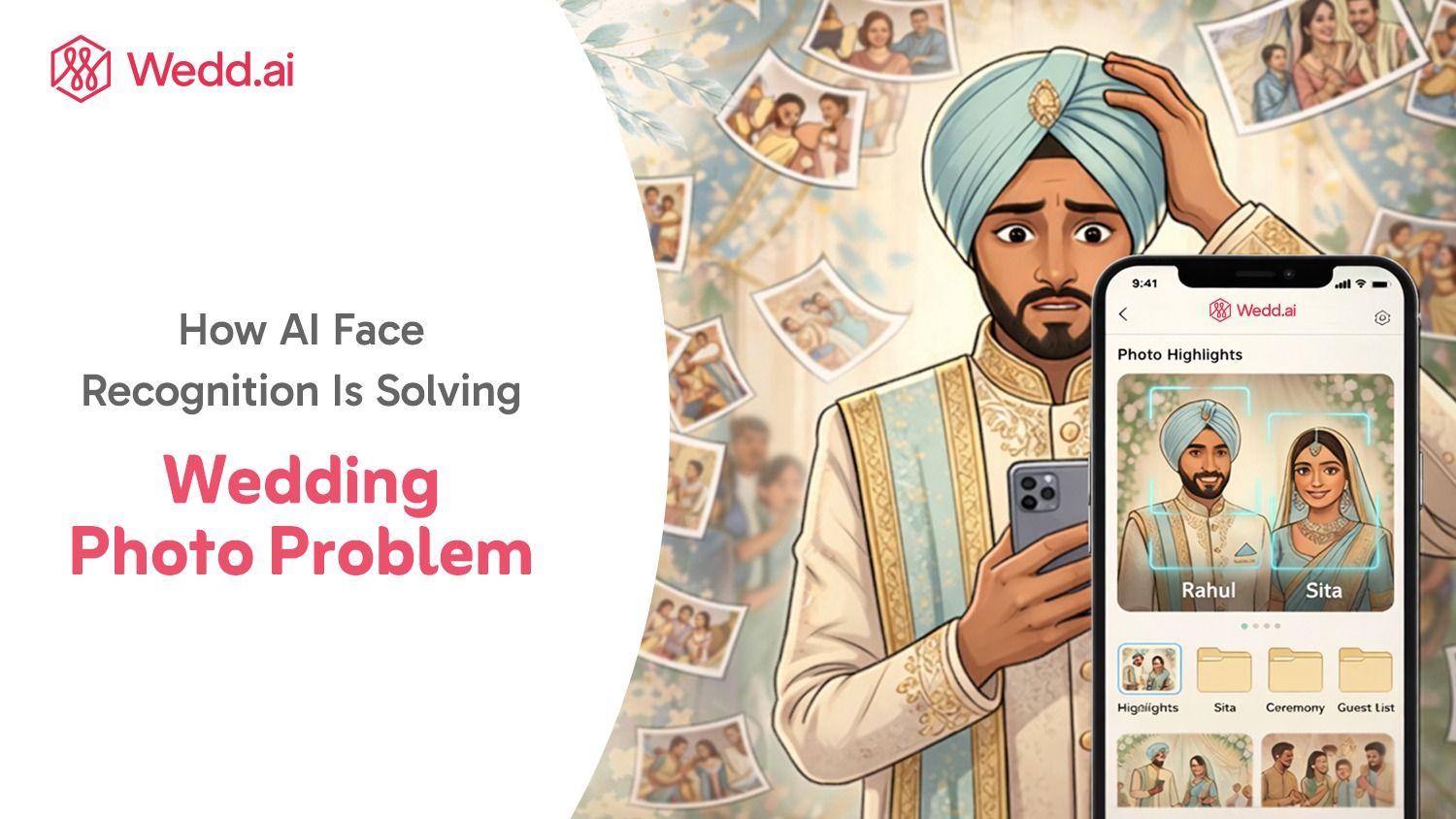
The last guest has left. The flowers are wilting. Somewhere, a photographer is staring at 9,000 RAW files and quietly reconsidering their career choices.
Meanwhile, the bride’s phone hasn’t stopped buzzing. Her Maasi wants the Haldi photos. Her college friends are asking about the Sangeet ones. Her mother-in-law is wondering why she hasn’t received anything yet — and it’s been four days. The photographer is still culling. The planner has moved on to next weekend’s event. And somewhere in a WhatsApp group, 200 compressed, blurry photos are slowly disappearing under a flood of “so cute!” messages.
This is where almost every Indian wedding ends up. Not in the beautiful album everyone imagined, but in a chaotic scatter of phone galleries, expired Drive links, and photographer delivery timelines that stretch into the following month.
The photography itself has gotten remarkably good. Candid photographers, cinematic reels, drone shots, same-day edits playing on screens during the reception — the craft has evolved. What hasn’t kept up is everything that happens after the shutter clicks.
For a photographer covering a multi-day wedding, post-production is often a bigger time sink than the shoot itself. Culling through thousands of near-identical burst shots. Building separate folders for different families. Figuring out which photos go to which guests. A photographer who shoots 15 weddings a year can spend as much time sorting and distributing as they do actually shooting — and none of that invisible labour shows up in the price clients pay.
The reason this problem has been so stubborn is that the tools people use were never designed to work together. Guest lists live in Excel. RSVPs come in over WhatsApp. Photos land in Google Drive or WeTransfer links that half the family can’t figure out. Each piece works in isolation, and someone — usually the planner, or an exhausted family member — ends up manually bridging the gaps between all of them.
Automatic Face Detection: No More Manual Sorting
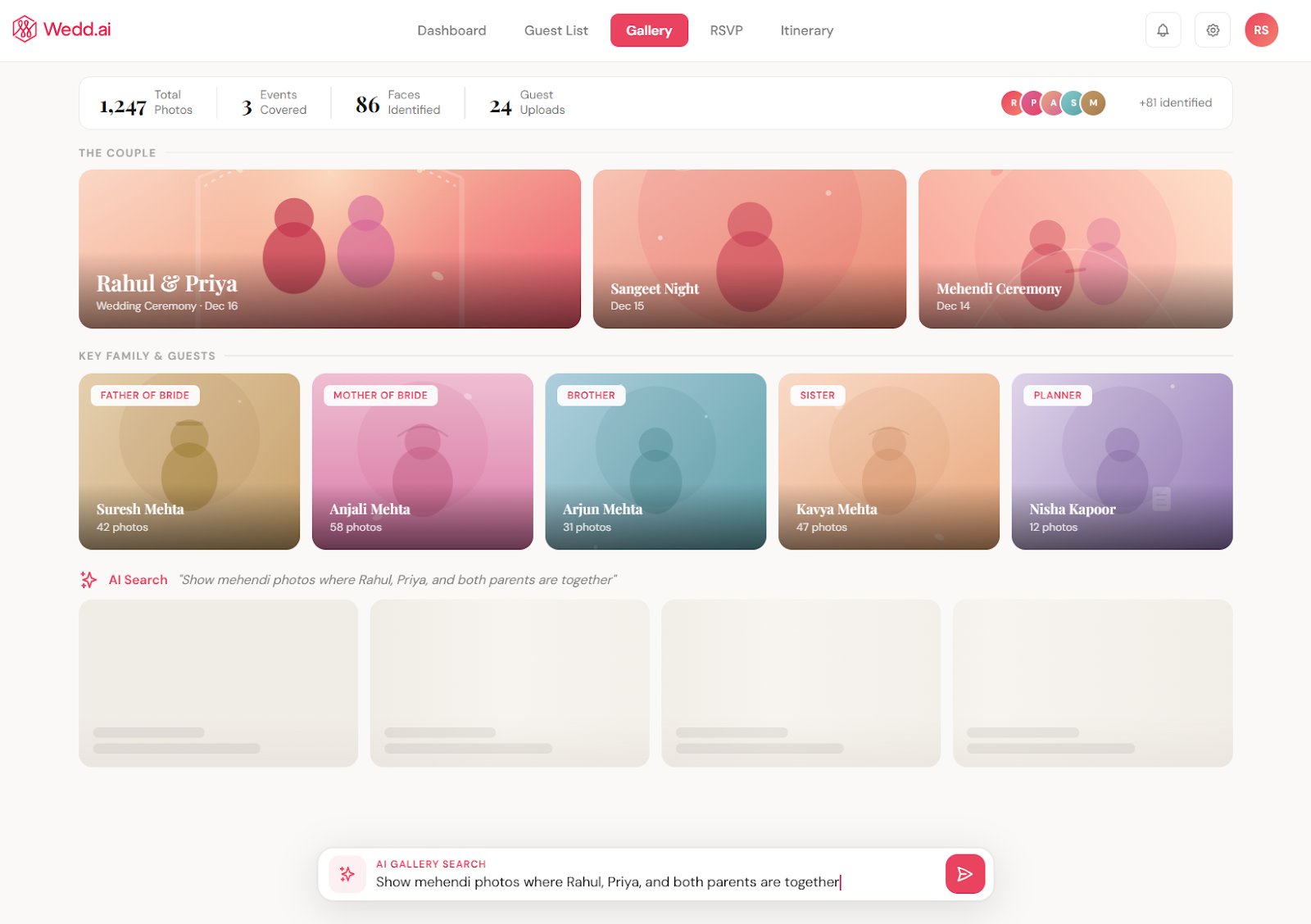
Dashboard for Wedding
With AI face recognition, the system scans every image, detects all faces, and clusters similar faces together automatically. Once it identifies a person — whether it’s the bride, the groom, or the bride’s nani — it pulls every photo containing that person from across all events and organises them into a single personalised gallery.
What makes Wedd.ai’s approach different is that the guest list and the photo gallery are the same platform. By the time the wedding happens, the system already has every guest’s name, their WhatsApp number, and which events they’re attending. When the photographer uploads photos after the wedding, face recognition isn’t identifying strangers from scratch — it’s cross-referencing people who are already in the system. It knows that the woman in the front row of the Sangeet photos is the bride’s masi from Pune, because she’s on the guest list and already confirmed her attendance via WhatsApp two weeks ago.
Personalised Guest Albums — Without Anyone Lifting a Finger
That connection is what makes the delivery actually work. The same WhatsApp channel that sent guests their RSVP reminders and event itinerary now sends them their personalized photo album — every photo they appear in, pulled from across all ceremonies, in full quality. No new app to download. No link to hunt for. It arrives in a conversation they’re already in, on a phone they’re already holding. Dadi doesn’t need to ask anyone. Chachaji’s photos don’t get lost because nobody thought to forward them.
QR Code-Based Instant Collection From Every Guest
Guests also capture moments the official photographer never sees — the cousin’s reaction during the varmala, the kids who fell asleep under the chairs, the chaos backstage before the baraat. Wedd.ai lets guests upload their own photos to the same gallery through a QR code at the venue, and those photos get folded into everyone’s personalised albums automatically. The couple ends up with a far more complete picture of their own wedding than any single photographer could provide.
Private, Secure Sharing — Because Not Everything Belongs on Instagram
There’s a quieter benefit here too. Once photos land in a WhatsApp group, you’ve lost control of them — screenshots travel, images get re-shared, and the candid Haldi photo where the bride genuinely looks like herself can end up anywhere. Because Wedd.ai’s gallery is private and access is tied to who’s on the guest list, the family’s photos stay inside the family. It’s not a feature most people think to ask for, but once a couple has experienced the alternative, it’s one they tend to mention.
For planners, this changes the shape of a job that often drags on well past the wedding day. Managing post-event photo requests, fielding messages from guests who can’t find their photos, chasing photographers for delivery updates — all of that typically falls on whoever is most organised and most reachable, which is usually the planner. When the photo delivery is automated and connected to a guest list that was already built, that tail end of the job largely takes care of itself. A couple whose photos arrived within days, without any chasing, remembers that. It’s the kind of thing that generates referrals.
Smart Duplicate Detection: Picking the Best Shot From 50 Identical Ones
Lots of people shoot in burst mode to guarantee at least one frame where no one is blinking, the dupatta is falling perfectly, and Chacha isn’t mid-blink in the background. That means dozens of nearly identical shots for every key moment.
AI tools analyse similar shots and rank them based on facial expressions, eye openness, sharpness, and composition — flagging the best frame automatically. What used to take a photographer hours of careful comparison now happens as part of the automated workflow, and the best images rise to the top.
The photos from a wedding are the only thing that outlasts it. The flowers are gone by morning. The food is a memory. What stays are the images — and for too long, the last mile of getting those images to the right people has been the weakest part of an otherwise meticulously planned day. It shouldn’t take a month, a dozen WhatsApp forwards, and a storage drive that may or may not still work in five years. The gap between “we have thousands of photos” and “everyone has their photos” has been filled by manual effort, good intentions, and a lot of waiting.
The tools to close that gap properly have arrived. Most weddings just aren’t using them yet.