How to Make a Wedding Guest List: A Step-by-Step Indian Guide
· Meera Kapoor · 11 min read
Introduction
Making a wedding guest list in India is never just your list. It is your parents' list, your in-laws' list, the relatives who expect a card, and somehow even the neighbours. Then comes the budget, because feeding 500 people is not cheap.
It starts simple: close family, best friends. Then come the "How can you not invite so and so?" conversations, and your intimate wedding starts to look like a mini festival.
This guide walks you through how to make a wedding guest list from the very first number to the final, locked list, in the order things actually need to happen. If your list is already too long, our guide on how to limit the wedding guest list covers the cutting. And if you want a ready-made sheet to fill in, the free wedding guest list template has the columns set up for you.
How to Make a Wedding Guest List: The Steps at a Glance
- Agree on the kind of wedding and a total number, based on budget and venue.
- Decide who builds the list and how the number is split between the two families.
- Write a full first draft, circle by circle.
- Sort everyone into A, B and C lists.
- Decide which functions each family is invited to.
- Set your rules for plus-ones and kids.
- Collect the details you need for every invite.
- Talk through family expectations and sensitive relationships.
- Lock the final list, send the invites and track RSVPs.
Here is each step in detail.
Step 1: Agree on the Kind of Wedding and a Total Number

Before anyone writes a single name, everyone involved in the planning has to agree on what kind of wedding this is. A big celebration with everyone you have ever met, or a smaller affair with just the closest people? Local or destination? Traditional, with every ritual, or a more relaxed celebration focused on friends? The answer shapes every number that follows.
Then turn that vision into a number using your budget and venue capacity. For example, if your wedding budget is ₹10,00,000:
- Total Budget: ₹10,00,000
- Venue and Catering Allocation: 50% of your budget → ₹5,00,000
Now, let's calculate catering:
- Cost per Guest: ₹1,000
- Number of Guests You Can Afford: ₹5,00,000 ÷ ₹1,000 (cost per guest) = 500 guests
With this budget, you can afford 500 guests for catering.
Next, check your venue capacity. If your venue only holds 200 guests, that is your real limit, even though the catering budget stretches to 500. Your guest count is always the smaller of the two numbers.
Do this early. In a typical 8 to 10 month wedding planning timeline, the rough guest count comes right at the start, because it decides which venues and caterers you can even shortlist.
Step 2: Decide Who Builds the List and How to Split It
In most Indian weddings, three groups add names: the bride's family, the groom's family and the couple themselves. Agree on two things before anyone starts writing.
How the number is split. There is no fixed rule. Families commonly use one of these:
- An equal split between the two sides, with a separate share for the couple's friends.
- A split by who is hosting. If one family is hosting a function, it often decides most of that function's list.
- A split by family size. If one side's family is much bigger, an equal split may simply not work.
Whichever you choose, say it out loud early. Most guest list fights come from two families assuming different rules.
Who owns each side's list. Name one person on each side, often a parent or an elder sibling, who collects that side's names. Relatives send names to them, not to the couple directly. It keeps the count honest and saves you from ten different versions of the same list on WhatsApp.
Step 3: Write a Full First Draft, Circle by Circle
Now write everyone down. Don't filter yet: it is far easier to cut from a complete list than to keep remembering people later. Going circle by circle stops anyone slipping through:
- Immediate family: parents, siblings, grandparents and their families.
- Extended family: chacha, mama, bua, mausi and their families, then cousins, then the wider khandaan.
- Family friends and community: your parents' close friends, people from your community, and families you exchange invitations with.
- Neighbours: current neighbours, and old ones your family is still close to.
- Your own friends: school, college and the friends you actually see now.
- Colleagues: your team and manager, and your parents' colleagues if they expect to invite them.
Sit with your parents for circles 2 to 4. They will remember the must-invite names you would never think of, and family expectations are much easier to handle now than after the cards are printed.
How to decide who to invite. For every name, ask a few honest questions:
- Would you notice if they were not there?
- Have you or your family been in touch in the last few years?
- Would you be invited to their family's wedding?
- Is this a must-invite for your parents, even if you don't know them well?
A clear "yes" usually means the A-list. A "maybe" goes on the B or C list for now.
Step 4: Sort Everyone into A, B and C Lists

Once the draft is complete, give every name a tier:
- A-list (must invite): immediate family, closest friends and anyone your parents will not budge on. This list does not get cut.
- B-list (would love to invite): extended family, close colleagues and friends you care about but don't see often.
- C-list (if there is room): distant relatives, acquaintances and plus-ones for unmarried guests.
Add up the A-list first and compare it with your number from Step 1. If the A-list alone is over the limit, go back to Step 1 with your families before going any further. Still over budget? These practical ways to limit the wedding guest list help you trim it without the family drama.
Step 5: Decide Who Is Invited to Which Function
An Indian wedding is rarely one event, so it should not have one guest list. Traditionally, the smaller functions are for the closer circles and the wedding and reception cover everyone:
| Function | Who is usually invited |
|---|---|
| Haldi | Immediate family and the closest friends |
| Mehendi | Close family, cousins and close friends |
| Sangeet | Family, friends and often the extended family |
| Wedding ceremony | The full list for the day |
| Reception | The full list, often including colleagues and wider circles |
Every family does this differently, so treat the table as a starting point. What matters is that you tick the functions for each family on your list, so you get a separate headcount for each event. The caterer, decorator and venue all need different numbers. When the invites go out, separate haldi, mehendi and sangeet invitation messages make sure nobody gets invited to a function they are not expected at.
Step 6: Set Your Rules for Plus-Ones and Kids
Decide these two rules once and apply them to everyone:
- Plus-ones: will every guest get one, or only those who are married or engaged? There is no right answer, only a consistent one.
- Kids: are children welcome at every function, or only some? If they are coming, count them in the headcount, and consider a kids' corner at the bigger events.
Whatever you decide, make it clear on the invitation, so guests can plan and nobody is caught off guard at the venue.
Step 7: Collect the Details You Need for Every Invite
A guest list is more than names. The easiest way to keep it organized is one row per invite (usually one family), with the same details collected for each:
- The name exactly as it should appear on the card, for example "Mr and Mrs Sharma and family"
- Bride's side or groom's side, and the relation
- Number of members coming
- WhatsApp number, for e-invites, reminders and RSVPs
- Postal address, if a printed card or mithai box is being delivered
- City, and whether they are local or outstation
- The functions they are invited to, from Step 5
Outstation families also need arrival dates, rooms and pickups, so flag them early. Our sample wedding guest list format shows all of these columns filled in for fictional families, so you can copy the layout. If your contacts live on your phone, here is how to import contacts as VCF on Android or export iPhone contacts as VCF.
Free guest list template
Build your wedding guest list in minutes
A ready-to-use sheet to track RSVPs, outstation guests, stays and headcounts, with both families on the same page.
Step 8: Talk Through Family Expectations
If your parents are paying for the wedding, or a big part of it, they will expect a say in who is invited. Talk about how much early: which functions they decide, which you decide, and where the line is. Clear boundaries now save a lot of stress later.
Sensitive relationships need a plan too. If there are divorced parents or relatives who don't get along, think ahead about room allocation and their roles in the rituals, so nobody is put in an awkward spot on the day. And if inviting someone out of obligation will create more tension than it is worth, it is fine to leave them off.
Balancing family traditions with your own choices is hard. Consider your family's wishes, but remember it is also your wedding.
Step 9: Lock the List, Send Invites and Track RSVPs
Pick a date to lock the list, and make it before the invitation cards go to print. After that date, a new name only comes in if someone else drops out.
Then:
- Count your cards by invite, not by person. One card addressed to a family covers everyone in it. Print a few extra for the names that inevitably come up late.
- Keep the B-list ready. As declines come in, invite from the B-list in order, so the empty spots go to the next people you wanted.
- Track RSVPs per function. A family may come to the wedding but skip the mehendi. Note each reply against each event, not just a single yes or no.
- Share the final numbers. Give the caterer function-wise headcounts, allocate hotel rooms so families stay together (and relatives who don't get along stay on different floors), and plan pickups for outstation guests.
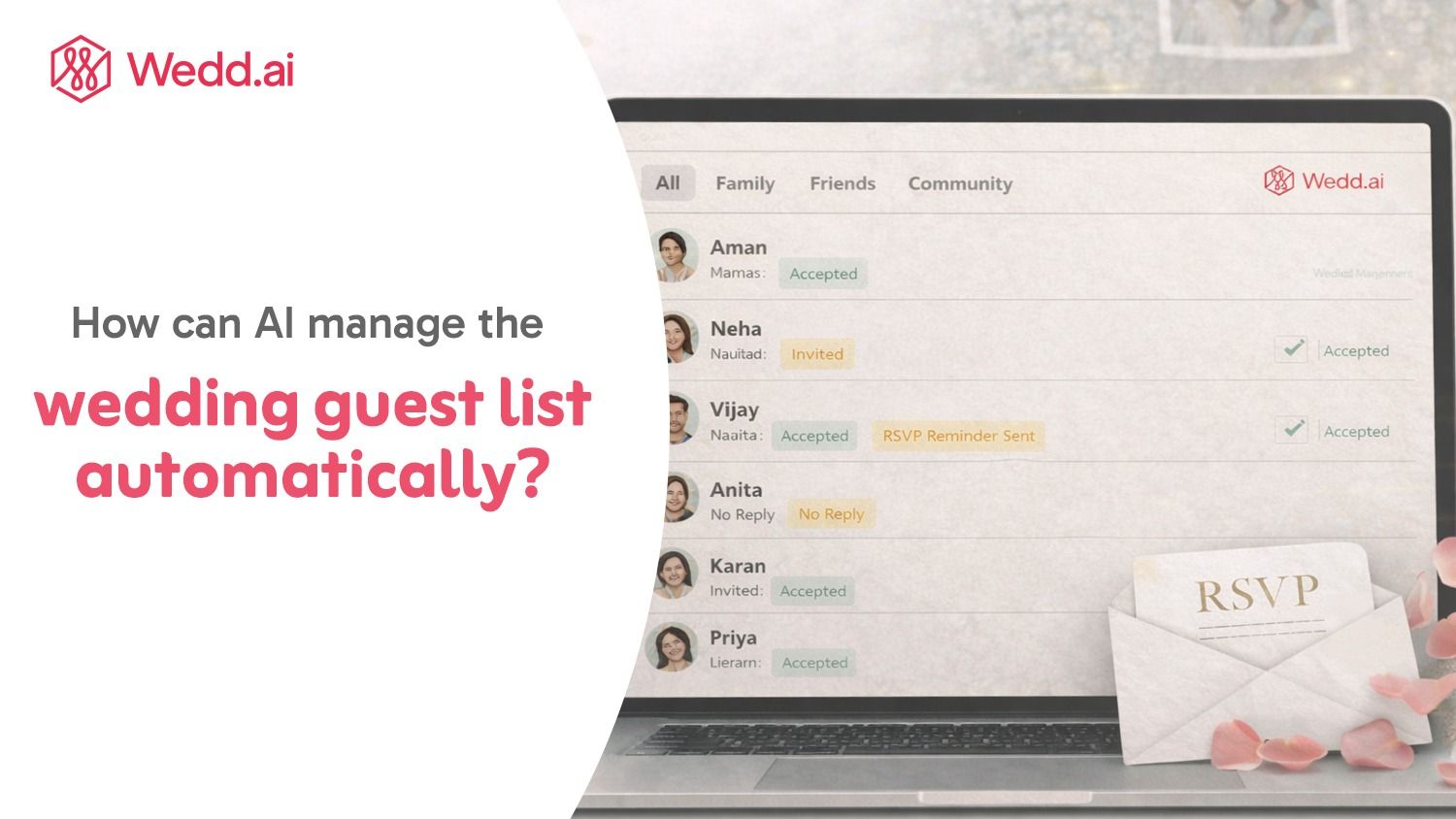
Spreadsheets work for simple lists. For a big Indian wedding, an RSVP tool like Wedd.ai saves a lot of chasing: both families upload their contacts, and in three simple steps you have a finalised guest list. The app groups similar guests together, tracks RSVPs and meal choices, and sends reminders to guests who haven't replied yet. Curious how much of this can run on its own? Here is how AI manages the wedding guest list.
Common Guest List Mistakes to Avoid
- Writing names before agreeing on a number. You end up cutting people you have already told.
- Keeping two separate family lists. Common relatives and friends get invited twice, and nobody knows the real total.
- Using one number for every function. The haldi and the reception should never have the same headcount.
- Forgetting the people who come with your guests. Kids, plus-ones and drivers of outstation families all add to the count.
- Telling people they are on the B-list. That list is for your eyes only.
Wrapping Up
Making a wedding guest list is mostly about doing things in the right order: the number first, then the split, then the names. Agree on the rules early, keep one shared list, and give every function its own headcount. Do that, and the list stops being a source of family drama and becomes what it should be: the people you want with you on the day.
Now take a deep breath and get ready to celebrate with your favourite people!
Frequently Asked Questions (FAQs)
How do I make a wedding guest list?
Agree on the kind of wedding and a total number first, using your budget and venue capacity. Split that number between the bride's side, the groom's side and the couple's own friends. Then write a full first draft circle by circle (immediate family, extended family, family friends, neighbours, your friends, colleagues), sort it into A, B and C lists, decide which functions each family is invited to, collect contact details and lock the list before the cards go to print.
How do you organize a wedding guest list for an Indian wedding?
Keep one master list with one row per invite (usually a family), and columns for side, relation, number of members, WhatsApp number, city, the functions they are invited to and their RSVP for each. One shared Google Sheet or a guest list app works better than separate lists, because both families can see the same numbers and duplicates show up quickly.
How do you decide who to invite to your wedding?
Go circle by circle and ask a few honest questions about each name: would you notice if they were not there, have you been in touch in the last few years, would you be invited to their family's wedding, and is this a must-invite for your parents. Names that pass go on the A-list. The rest wait on the B or C list until you know how much room you have.
Who makes the guest list in an Indian wedding?
Usually both families and the couple do, together. Parents add relatives and family friends, and the couple adds their own friends and colleagues. It helps to name one person on each side who owns that side's list, so names come through them instead of from every relative separately.
How should the bride and groom's families split the guest list?
There is no fixed rule. Some families split the total equally, some split it by who is hosting or paying for each function, and some go by how big each family actually is. Pick one approach, agree on it before anyone starts writing names, and keep a shared count so both sides can see where the number stands.
When should you start making the wedding guest list?
Start a rough count as soon as you begin shortlisting venues, because the number decides which venues and caterers work for you. In a typical 8 to 10 month planning timeline, that is right at the start. The final list should be locked before invitation cards go to print.